
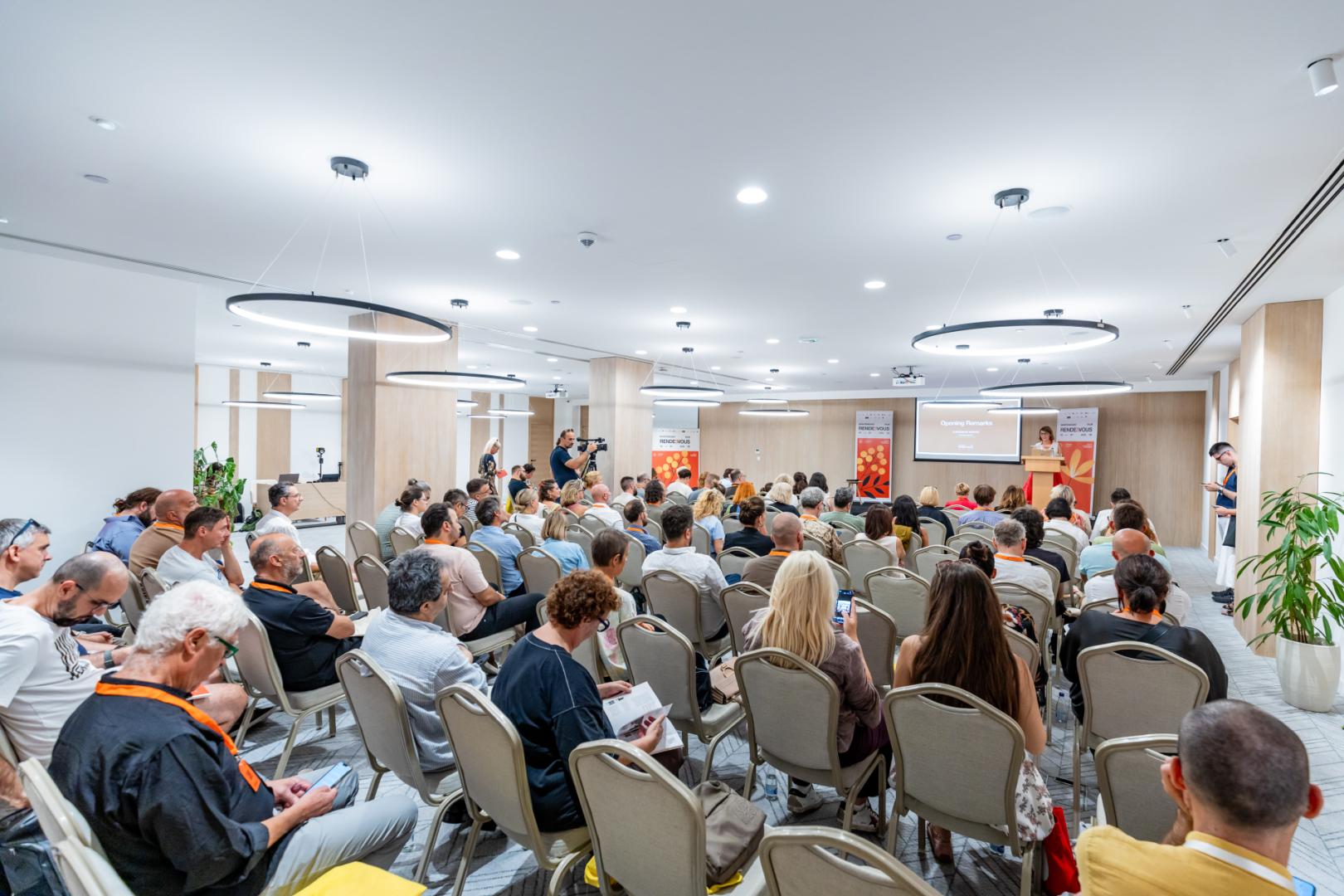
The authenticity of Montenegrin film stories, international connections and concrete opportunities for the development of film projects marked the third edition of Montenegro Film Rendezvous, which from 22 to 28 August in Herceg Novi brought together local filmmakers and representatives of the European, global and African film industries.
Organised by the Film Centre of Montenegro, this year's Rendezvous was extended from three to seven days. Alongside presentations of Montenegrin and guest film projects in development, the programme included masterclasses, case studies, international meetings, conversations about co-productions and funds, as well as workshops dedicated to the development of new projects and talent. The programme gathered more than 120 participants from over 30 countries, and 15 Montenegrin film projects at various stages of development were presented.
Aleksandra Božović, Director of the Film Centre of Montenegro and President of the Council of the Herceg Novi Film Festival – Montenegro Film Festival, stressed that one of the most important goals of Montenegro Film Rendezvous is connecting Montenegrin filmmakers with experts from the European and global film industries.
“We believe that all the projects we have supported and all the authors creating them have potential. What confirms everything we do is the fact that our friends and colleagues, as well as representatives of the European and global film industry, recognise the potential in the projects of Montenegrin authors, that they come and return year after year, and that there are more of them every year,” said Božović.
The central segment of the programme was the presentation of Montenegrin film projects in development. Film experts from Montenegro and abroad had the opportunity to learn about the projects Fires by director Nina Tratnik, Happiness Is Just a Blue Couch Away by Andrija Mugoša, Comedown by director Pavle Simonović, Echo by Ivica Vidanović, Embryo by Maša Šarović and Balkan Maestro, directed by Altinaï Petrovitch Njegosh and François Fleury.
The projects were presented through pitching sessions, and at the end of the third day the authors and producers had scheduled one-on-one meetings with festival selectors, directors of national funds, sales agents and producers.
Three Montenegrin documentaries in the final stage of post-production were also presented within Montenegro Film Rendezvous: Montenegro Star: The Sample of Janko Nilović by director Nikola Vukčević, The Rear Admiral by director Mladen Ivanović and About a Brother by Đorđe Vojvodić.
The international character of Montenegro Film Rendezvous was further expanded this year by the New African Voices programme, dedicated to presenting film projects, films and authors from francophone Africa. The programme was organised in partnership with the French Embassy and the French Institute in Montenegro and the Organisation internationale de la Francophonie (OIF). Its guests were Tunisian director Erige Sehiri, whose film Promised Sky screened at the Herceg Novi Film Festival, Cameroonian director and producer Cyrielle Raingou, Tunisian director and producer Afef Ben Mahmoud, and Jules Dieng, producer of the film Fighters. The programme was hosted by Enrico Chiesa of the Organisation internationale de la Francophonie.
Masterclasses by internationally recognised filmmakers, as well as a case study dedicated to the film To Hold a Mountain, were an important segment of this year's Rendezvous.
Manuel Alberto Claro, one of Europe's most respected directors of photography, whose latest film Dom (Home), directed by Marijana Jancovic, opened the 39th Herceg Novi Film Festival, held a masterclass devoted to cinematography and visual storytelling. A long-time collaborator of Lars von Trier, he shared his experience and thoughts on the visual language of film, working with directors and the process of creating the film image.
“Being a director of photography means fitting into a project together with a large number of other people. You can be brilliant, but if you do not allow your collaborators to shine, the project will be bad. You have to let everyone shine, and this is above all about balance and aligning different energies,” Claro said.
British sound editor Nina Hartstone, winner of the Academy Award for Best Sound Editing for Bohemian Rhapsody, held a masterclass dedicated to shaping sound and to the working process on contemporary film productions. One of her messages to the participants was that sound should be considered much earlier in the filmmaking process, and not only in the final stage of production.
“I hope people will become interested in sound and realise how important it is for storytelling. Maybe they will start thinking about sound a little earlier in the process, already in pre-production and during production itself, instead of leaving everything for the end,” Hartstone said.
The masterclass of Asghar Farhadi, winner of two Academy Awards for Best International Feature Film, was moderated by Vuk Perović. Farhadi spoke about his authorial approach, his experience of working in different languages and cultures, and the relationship between image, sound and story in the filmmaking process. Speaking about his latest film Parallel Tales, which premiered at the Cannes Film Festival, he also reflected on the way he connected the influence of Kieślowski with his own film language.
“This project was an opportunity for me to explore the relationship between image and sound and the way these elements complement each other in making a film. I found inspiration in Kieślowski and his approach to cinema, but I wanted to connect those elements with my own authorial style. In the end the film became a fusion of those two worlds, a homage to the cinema that inspired me and to my personal film language,” Farhadi said.
A case study dedicated to the documentary To Hold a Mountain, presented by directors Biljana Tutorov and Petar Glomazić, was also held within Montenegro Film Rendezvous. The Film Centre of Montenegro was the first national film institution to support the project. Tutorov stressed that the authors did not distinguish between local and global film, nor between documentary and fiction, but approached To Hold a Mountain as a cinematic project from the very beginning.
“We do not think about film in terms of local and global, not even documentary and fiction. Film is film. That is the only clear definition. We were interested in finding a way to nurture the language of that film,” said Tutorov.
Glomazić pointed out that they could not have expected the success the film achieved. After screenings at various festivals, he said, it became clear that the film manages to cross different cultural barriers and that the emotions and reflections it carries reach audiences in different parts of the world.
A new segment of the programme, Montenegro Film Rendezvous Plus, included a series of specialised workshops for Montenegrin and regional filmmakers and talents, organised with the support of the Film Centre's international partners.
The ReActing+ workshop, a new module of the ReActing as a Star programme intended for talented actors from the region, was organised with the support of the British Council, while the Female Filmmakers workshop, dedicated to promising women directors from the Western Balkans, Moldova and Armenia, was organised in partnership with the Embassy of France and the French Institute in Montenegro.
The EAVE on Demand RE-ACT workshop, also held within this year's programme, focused on developing producers' capacities and the sustainability of production companies. The MEDIA TV Series Event opened space for the development of television projects. The programme was organised as a joint initiative of the Creative Europe MEDIA Desks of Montenegro, Serbia, Greece, Bulgaria and Croatia, and included a panel on regional co-production, a masterclass and a case study.
Special attention was devoted to opportunities for developing co-productions and cooperation between national film funds. The work of the Hubert Bals Fund of the International Film Festival Rotterdam was presented by its Head, Tamara Tatishvili, while opportunities for cooperation with the Baltic countries were presented by Dita Rietuma, Director of the National Film Centre of Latvia, and Edith Sepp, CEO of the Estonian Film Institute.
The seven-day format of Montenegro Film Rendezvous is not only an extension of its duration, but also a confirmation of the programme's increasingly wide role. Herceg Novi is increasingly positioning itself as a place where Montenegrin cinema is presented to the world and as a meeting point for local authors and international film professionals, where projects are developed, knowledge is exchanged and new partnerships are formed. It is precisely in this combination of authenticity and openness to the world that the essential value of the Rendezvous lies: for Montenegrin cinema to preserve its own voice, while being connected enough to be heard by audiences and the film industry beyond the country's borders.
Autentičnost crnogorskih filmskih priča, međunarodno povezivanje i konkretne prilike za razvoj filmskih projekata obilježili su treće izdanje programa Montenegro Film Rendezvous, koji je u Herceg Novom od 22. do 28. avgusta okupio domaće filmske stvaraoce i predstavnike evropske, svjetske i afričke filmske industrije. U organizaciji Filmskog centra Crne Gore, ovogodišnji Rendezvous produžen je sa tri na sedam dana, a uz predstavljanje crnogorskih i gostujućih filmskih projekata u razvoju program je obuhvatio masterklasove, studije slučaja, međunarodne susrete, razgovore o koprodukcijama i fondovima, kao i radionice posvećene razvoju novih projekata i talenata. Program je okupio više od 120 učesnika iz preko 30 zemalja, a predstavljeno je 15 crnogorskih filmskih projekata u različitim fazama razvoja. Direktorica Filmskog centra Crne Gore i predsjednica Savjeta Filmskog festivala Herceg Novi – Montenegro Film Festival Aleksandra Božović istakla je da je jedan od najvažnijih ciljeva programa Montenegro Rendezvous povezivanje crnogorskih filmskih stvaralaca sa ekspertima iz evropske i svjetske filmske industrije. „Mi vjerujemo da svi projekti koje smo podržali i autori koji stvaraju imaju potencijala. Ono što potvrđuje sve ono što radimo jeste činjenica da naši prijatelji, kolege, kao i predstavnici evropske i svjetske filmske industrije, u projektima crnogorskih autora prepoznaju potencijal, dolaze i iz godine u godinu se vraćaju, a svake godine ih je sve više“, kazala je Božović. Centralni segment programa bio je predstavljanje crnogorskih filmskih projekata u razvoju. Filmski eksperti iz zemlje i inostranstva imali su priliku da se upoznaju sa projektima „Požari“ rediteljke Nine Tratnik, „Pu spas za sve nas“ Andrije Mugoše, „Sobe“ reditelja Pavla Simonovića, „Odjek“ Ivice Vidanovića, „Plod“ Maše Šarović i „Balkan Maestro“, koji režiraju Altinaj Petrović Njegoš i Fransoa Fleri (François Fleury). Projekti su predstavljeni kroz pitching sesije, a na kraju trećeg dana autori i producenti imali su zakazane individualne sastanke sa selektorima festivala, direktorima nacionalnih fondova, prodajnim agentima i producentima. U okviru programa Montenegro Film Rendezvous prikazana su i tri crnogorska dokumentarna filma u finalnoj fazi postprodukcije: „Montenegro star: Sempl Janka Nilovića“ (Montenegro Star: The Sample of Janko Nilovic) reditelja Nikole Vukčevića, „Kontraadmiral“ (The Rear Admiral) reditelja Mladena Ivanovića i „Film o bratu“ (About a Brother) Đorđa Vojvodića. Međunarodni karakter programa Montenegro Film Rendezvous ove godine dodatno je proširen programom Novi afrički glasovi, posvećenim predstavljanju filmskih projekata, filmova i autora iz frankofone Afrike. Program je realizovan u partnerstvu sa Francuskom ambasadom i Francuskim institutom u Crnoj Gori i Međunarodnom organizacijom frankofonije – OIF. Gosti programa bile su tuniska rediteljka Erige Sehiri (Erige Sehiri), čiji je film „Promised Sky“ prikazan u okviru Filmskog festivala Herceg Novi, rediteljka i producentkinja iz Kameruna Sirijel Rengu (Cyrielle Raingou), tuniska rediteljka i producentkinja Afef Ben Mahmud (Afef Ben Mahmoud), kao i producent filma „Fighters“, Žil Dijeng (Jules Dieng). Program je vodio Enriko Kjeza (Enrico Chiesa), iz Međunarodne organizacije frankofonije – OIF. Važan segment ovogodišnjeg Rendezvousa činili su i masterklasovi međunarodno priznatih filmskih stvaralaca, kao i studija slučaja posvećena filmu „Planina“. Manuel Alberto Klaro (Manuel Alberto Claro), jedan od najcjenjenijih evropskih direktora fotografije, čiji je posljednji film „Dom“ u režiji Marijane Janković otvorio 39. Filmski festival Herceg Novi, održao je masterklas posvećen filmskoj fotografiji i vizuelnom pripovijedanju. Dugogodišnji saradnik Larsa fon Trira sa učesnicima je podijelio svoja iskustva i razmišljanja o vizuelnom jeziku filma, radu sa rediteljima i procesu stvaranja filmske slike. „Biti direktor fotografije znači uklopiti se u projekat zajedno sa velikim brojem drugih ljudi. Možete biti sjajni, ali ako ne omogućite svojim saradnicima da briljiraju, projekat će biti loš. Morate svima omogućiti da zablistaju i ovdje se prije svega radi o ravnoteži i usklađivanju različitih energija“, istakao je Klaro. Britanska filmska montažerka zvuka i dobitnica Oskara za najbolju montažu zvuka za film „Bohemian Rhapsody“, Nina Hartston (Nina Hartstone), održala je masterklas posvećen oblikovanju zvuka i procesu rada na savremenim filmskim produkcijama. Jedna od njenih poruka učesnicima programa bila je da o zvuku treba razmišljati mnogo ranije u procesu nastanka filma, a ne tek u završnoj fazi produkcije. „Nadam se da će se ljudi zainteresovati za zvuk i shvatiti koliko je važan za pripovijedanje. Možda će početi da razmišljaju o zvuku malo ranije u procesu, već u pretprodukciji i tokom same produkcije, umjesto da sve ostave za kraj“, istakla je Hartston. Masterklas Asgara Farhadija (Asghar Farhadi), dobitnika dva Oskara za najbolji strani film, moderirao je Vuk Perović. Farhadi je govorio o svom autorskom pristupu, iskustvu rada na različitim jezicima i u različitim kulturama, kao i o odnosu slike, zvuka i priče u procesu stvaranja filma. Govoreći o svom posljednjem filmu „Parallel Tales“, koji je premijerno prikazan na Festivalu u Kanu, osvrnuo se i na način na koji je uticaje Kješlovskog povezao sa sopstvenim filmskim jezikom. „Ovaj projekat je za mene bio prilika da istražim odnos između slike i zvuka i način na koji se ti elementi međusobno dopunjuju u stvaranju filma. Inspiraciju sam pronašao u Kješlovskom i njegovom pristupu filmu, ali sam želio da te elemente povežem sa sopstvenim autorskim stilom. Na kraju je film postao spoj ta dva svijeta – omaž kinematografiji koja me je inspirisala i mom ličnom filmskom jeziku“, kazao je Farhadi. U okviru programa Montenegro Film Rendezvous održana je i studija slučaja posvećena dokumentarnom filmu „Planina“, koji su predstavili reditelji Biljana Tutorov i Petar Glomazić. Filmski centar Crne Gore bio je prva nacionalna filmska institucija koja je podržala projekat. Tutorov je istakla da autori nisu pravili razliku između lokalnog i globalnog filma, niti između dokumentarnog i igranog, već su „Planinu“ od početka posmatrali kao kinematografski projekat. „Mi ne razmišljamo o filmu lokalno-globalno, čak ni dokumentarno-igrano. Film je film. To je jedina jasna odrednica. Zanimao nas je način da odnjegujemo jezik tog filma“, kazala je Tutorov. Glomazić je istakao da nisu mogli očekivati uspjeh koji je film ostvario. Nakon prikazivanja na različitim festivalima, kako je naveo, postalo je jasno da film uspijeva da pređe različite kulturne barijere i da emocije i refleksije koje nosi dopiru do publike u različitim djelovima svijeta. Novi segment programa, „Montenegro Film Rendezvous Plus“, obuhvatio je niz specijalizovanih radionica za crnogorske i regionalne filmske stvaraoce i talente, realizovanih uz podršku međunarodnih partnera Filmskog centra. Radionica ReActing+, novi modul programa ReActing as a Star, namijenjena talentovanim glumcima iz regiona, organizovana je uz podršku Britanskog savjeta, dok je radionica Female Filmmakers, posvećena perspektivnim rediteljkama Zapadnog Balkana, Moldavije i Jermenije, realizovana u partnerstvu sa Ambasadom Francuske i Francuskim institutom u Crnoj Gori. EAVE on Demand RE-ACT radionica, takođe održana u okviru ovogodišnjeg programa, bila je usmjerena na razvoj producentskih kapaciteta i održivost produkcionih kuća. Kroz MEDIA TV Series Event otvoren je i prostor za razvoj televizijskih projekata. Program je realizovan kao zajednička inicijativa Creative Europe MEDIA deskova Crne Gore, Srbije, Grčke, Bugarske i Hrvatske, a obuhvatio je panel o regionalnoj koprodukciji, masterklas i studiju slučaja. Posebna pažnja posvećena je mogućnostima za razvoj koprodukcija i saradnji između nacionalnih filmskih fondova. Rad fonda Hubert Bals Međunarodnog filmskog festivala u Roterdamu predstavila je njegova direktorka Tamara Tatišvili (Tamara Tatishvili), dok su mogućnosti saradnje sa baltičkim zemljama predstavile Dita Rietuma (Dita Rietuma), direktorica Nacionalnog filmskog centra Letonije, i Edit Sep (Edith Sepp), direktorica Estonskog filmskog instituta. Sedmodnevni format programa Montenegro Film Rendezvous nije samo proširenje njegovog trajanja, već i potvrda sve šire uloge programa. Herceg Novi se sve više pozicionira kao prostor u kojem se crnogorski film predstavlja svijetu i mjesto susreta domaćih autora i međunarodnih filmskih profesionalaca, na kojem se razvijaju projekti, razmjenjuju znanja i ostvaruju nova partnerstva. Upravo u tom spoju autentičnosti i otvorenosti prema svijetu ostaje i osnovna vrijednost Rendezvousa – da crnogorski film sačuva vlastiti glas, ali bude dovoljno povezan da ga čuju publika i filmska industrija izvan granica zemlje.
.png)


